
Why software architecture matters for interns

My internship at Ascentic is coming close to its end, and I’ve been thinking about what actually stuck. The code I wrote will get refactored. The features I shipped will change. The one thing I’ll carry into every job after this is learning to think architecturally. This is my attempt to pass that on to the interns and junior devs who come next.
What software architecture as, and why it matters to interns
Software architecture is the high-level shape of a system: how the pieces are organized, how they talk to each other, and how the whole thing holds up as it grows. The usual comparison is a building. An architect decides where the walls and rooms go before anyone lays a brick, because those early choices determine whether the building survives the next thirty years.
As an intern, you get pulled toward the task in front of you. Fix the bug, build the component, write the endpoint. That’s fine, but if you don’t know the blueprint your team is building against, you’re laying bricks without knowing whether you’re making a shed or a tower.
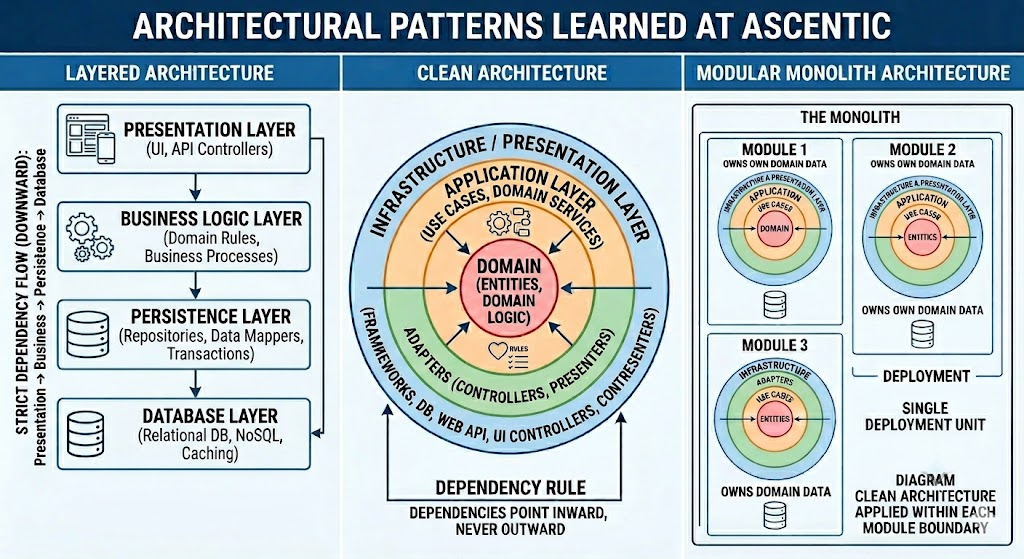
At Ascentic I got introduced to a few architectural styles: Layered, Clean, Monolithic, and Modular Monolith with Clean Architecture inside each module. Knowing why those patterns existed, made me useful a lot sooner than I would have been otherwise.
Seeing the big picture beyond your tasks
Tunnel vision is the first trap. You grab a ticket, write the code, open the PR, repeat. But the work isn’t a pile of unrelated tasks. Every feature lives inside a bigger system, and every choice you make travels through it.
Something clicked when I understood our project was a Modular Monolith with Clean Architecture in each module. Suddenly the layout made sense: why some layers couldn’t reference others, why the boundaries between modules were guarded so carefully. It changed how I worked.
Seeing the big picture is really just asking a few questions:
- Where does this feature fit in the system that already exists?
- Which module or layer does this change actually belong to?
- Is this going to make scaling or maintenance harder later?
Interns who ask these questions get noticed. They’re thinking like engineers, and people can tell.
Architecture patterns every intern should know
At Ascentic I got to study and work with a handful of key patterns. Here’s what I took from each.
Layered architecture is one of the oldest patterns around. Code gets split into horizontal layers, usually presentation, business logic, and data access, and each layer only talks to the one directly beneath it. It’s easy to reason about and a sensible first model for how a codebase separates concerns.
Clean architecture, which Robert C. Martin (Uncle Bob) popularized, pushes that separation harder. Business rules and domain logic sit at the center, with no knowledge of frameworks, databases, or UI. The dependency rule says code can only point inward, toward that core. Working with it at Ascentic drilled in a habit I didn’t have before: keep the business logic clean and unaware of everything around it.
Modular monolith is the one we actually used, and the one that surprised me most. You get the deployment simplicity of a monolith with code organization closer to microservices. Each module owns its domain and has a clear boundary, and inside each module we ran Clean Architecture. Organized, maintainable code, minus the operational headache of running a distributed system.
Running into all of these as an intern is lucky. A lot of developers meet them one at a time over years.
How AI is reshaping the architectural landscape
I didn’t expect to think about this during an internship, but it was hard to avoid: AI tools are changing how software gets written, and that lands directly on architecture.
Copilot, ChatGPT, and Cursor produce working code fast. I leaned on them to scaffold boilerplate, look up patterns I didn’t know, and get unstuck on unfamiliar syntax. They made me quicker. The catch is that the code they hand you doesn’t know where it lives. It works on its own, but it has no idea which layer it belongs in, whether it just crossed a module boundary, or whether it reinvented something that already exists three folders over. Accept those suggestions without thinking and you pile up inconsistent, messy code in a hurry.
That’s why knowing your architecture counts for more now than it used to. When Clean Architecture is in your head, you can read an AI suggestion the way you’d read a teammate’s PR: does this logic belong in the domain layer, does it drag in a dependency it shouldn’t, does it respect the module boundary? Without that model you’re just shipping whatever compiles.
There’s a bigger shift too. AI is moving into the systems themselves. Semantic search, recommendation engines, automation, often built as their own services or modules. Figuring out where an AI service sits in a layered or modular design, and how to keep it from tangling with core business logic, is turning into a real skill. I got a small taste of it at Ascentic, and I’d bet it only grows from here.
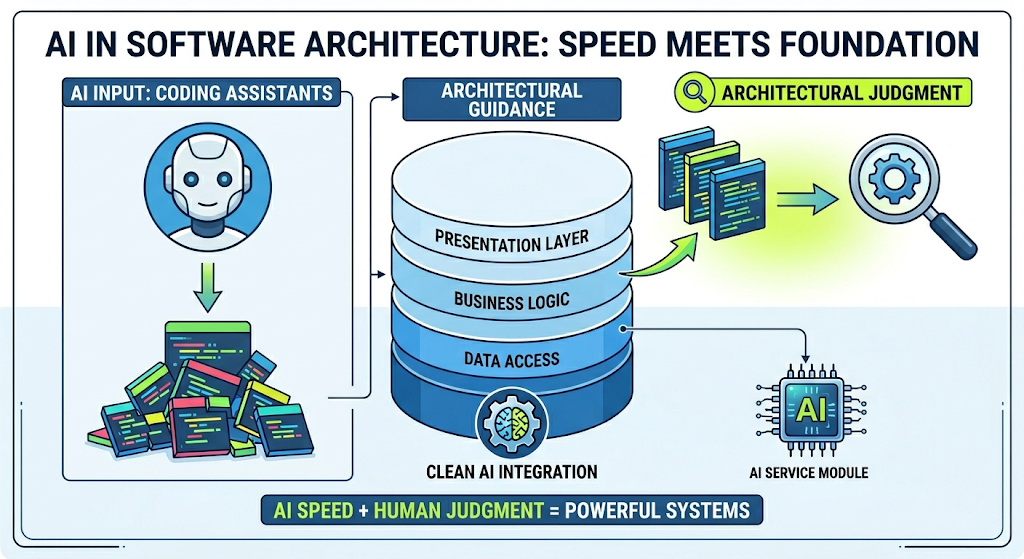
So the advice for interns is simple. Let the tools make you fast, but let your architecture sense decide what you keep and where it goes. Speed plus judgment is the good combination. Either one on its own runs out of road quickly.
How architecture knowledge makes you a better team player
Software gets built by teams, and architecture is the vocabulary teams use to talk about structure and decisions. Understand it and you’re a lot easier to work with.
At Ascentic, knowing our Modular Monolith and Clean setup meant code reviews actually went somewhere. When a reviewer flagged a dependency crossing a module boundary, I knew what they meant and, better, I knew how to fix it. Without that context it would have been one more arbitrary rule to obey.
It helps in smaller ways too. Your PR descriptions get clearer. You speak up in design discussions instead of nodding along. You start seeing feedback coming before it arrives. Your teammates spend less time explaining their reasoning, and you spend less time lost.
Reading and navigating codebases with confidence
Walking into a big unfamiliar codebase is one of the scarier parts of joining a team. With no architectural map in your head, it’s a city with no street signs.
Knowing the pattern fixes that. Once I learned the Ascentic project was Clean Architecture inside a Modular Monolith, I knew where things would be before I opened a folder:
- Domain entities and business rules in the innermost layer
- Use cases and application logic just outside that
- Infrastructure, database access, external APIs, and Azure integrations at the outer edge
- Every module repeating that same shape on its own
I could find my way around in the first week without anyone walking me through every directory. It also taught me the .NET side more deeply: how the projects fit together, how dependency injection got wired up, how the app bootstrapped itself. The frontend was the same story. Once I saw that React and Next.js components live at the presentation layer, it was obvious where UI logic went and where it didn’t.
Writing code that fits the system, not just the task
Code that works and code that fits aren’t the same thing. Working code solves the problem in front of you. Code that fits solves it in a way that matches the system’s design, that the next person can maintain, and that sits in the right place.
Interns reach for the fastest route to green. But a solution dropped in the wrong layer or module causes trouble later. It couples things that should stay apart, makes the next change harder, and leaves the following developer confused.
Clean Architecture trained me to keep asking one question: where does this logic actually go? A business rule goes in the domain. An orchestration step goes in the use case. A database call goes in the repository. An HTTP request goes in infrastructure. Once those boundaries are second nature, placing code well stops being a decision and starts being a reflex. It carried across everything, whether I was writing a .NET endpoint, a React component, or setting up an Azure pipeline. Knowing where code belongs turned out to matter as much as knowing how to write it.
Real-world consequences of ignoring software architecture
Architecture isn’t only theory. Ignore it and teams pay for it daily. A few of the ways that plays out:
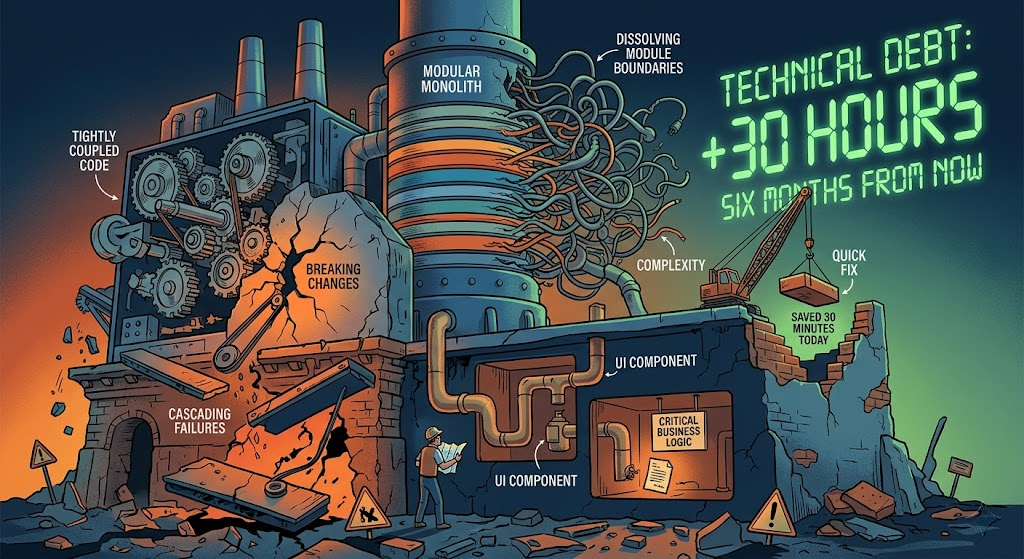
- Tightly coupled code can’t be changed without breaking something elsewhere. A small fix turns into days of tracing dependencies and patching things that fall over downstream.
- Business logic in the wrong place, say a key rule hidden inside a database query or a UI component, goes invisible to everyone else and becomes almost impossible to test on its own. When the requirement changes, good luck finding it.
- Fuzzy module boundaries in a Modular Monolith let modules quietly start depending on each other. The separation erodes, and you wind up with the downsides of a monolith and a distributed system at once, and the benefits of neither.
- Skipping conventions for a quick fix builds technical debt, and that debt charges interest. Thirty minutes saved today can cost thirty hours half a year from now.
Spotting these early is the payoff. As an intern you usually can’t rewrite architectural decisions, but you can avoid making things worse, and that counts for plenty.
How to build an architecture mindset early in your career
The encouraging part is that you can start building this as an intern. Here’s roughly how I went about it.
- Read the codebase on purpose. Don’t stop at the files your ticket touches. Poke around the folder structure, get a feel for how the project is organized, and ask your mentor for a walkthrough of the high-level design early on. That hour pays you back on every task afterward.
- Ask “why,” not just “how.” When a senior dev leaves feedback, fix it, then ask why it matters structurally. Most of them are glad to explain, and those few minutes are some of the best learning you’ll get.
- Read the foundational stuff. Clean Architecture by Robert C. Martin and Designing Data-Intensive Applications by Martin Kleppmann gave me ways to think about structure that no tutorial did. Even a few chapters moved the needle.
- Use AI tools with a critical eye. Copilot, ChatGPT, Claude Code, whatever your team runs, treat the output like a suggestion from a junior dev. Does it fit the architecture? Then keep it. The aim is faster and cleaner, not just faster.
- Tie the tech back to the whole. While I was learning .NET, React, Next.js, and Azure, I kept asking how each one slotted into the architecture. Azure deployments made a lot more sense once I understood how the Modular Monolith was packaged and shipped as a single unit.
- Stay curious instead of intimidated. Architecture feels like a lot at first, but every big system is just a stack of small, understandable decisions. Learn the pattern your current project uses, really learn it, and the rest opens up on its own.
Closing thoughts
My internship is wrapping up and I’m walking away with more than a list of technologies. I’m leaving with a way of looking at software: systems instead of files, patterns instead of syntax, the cost six months out instead of the fix that works today.
If I could hand a new intern one piece of advice, it would be this: learn the architecture before you write anything. It makes the rest of it, the coding, the reviews, the debugging, easier and faster. And as AI takes on more of the building, that architectural footing is what separates the people who use it well from the people who just use it fast.
Thanks to the team at Ascentic. They gave me space to learn how we build, and then they explained why, which turned out to be the part that mattered most.